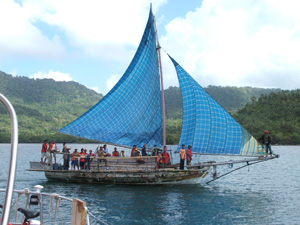
The only other boat in the anchorage in Damar, Indonesia
Sailing Faith: The Long
Way Home
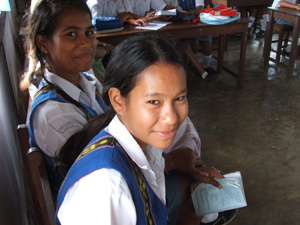
Rani (foreground) and Eti became close friends with Emily and Amanda
The Gregg A Granger
Family Adventure

| home |
| the long way home |
| blog |
| destinations |
| passages |
| contact |
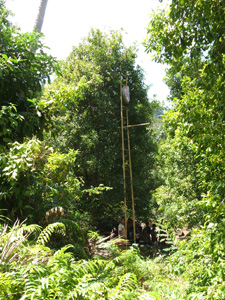
Harvesting cloves from a tall, bamboo ladder in Damar
Indonesia
We struggle to draft a concept of Indonesian culture, and realize the futility of it. The one element that spans all areas of Indonesia is the government, though the more populated areas share a common tongue: Bahasa Indonesia. Indonesia has no dominant culture, but instead attempts to unite hundreds, maybe thousands of disparate cultures—cultures with less in common than all western nations have with each other.
We find an enchanting land struggling for identity between ancient and modern cultures—ancient cultures with individual identities on each island group, or on larger islands, identities separated by terrain, and a modern culture with some elements attempting to maintain tradition, some attempting to maintain a cohesive nation, and some attempting to move the nation toward production on a global scale, all overlaid with outside influences extracting Indonesia’s profits. (page 93)
Saumlaki
An emotional undercurrent develops in our lives, urging us to scratch deeper into our beliefs about who we are and why we’re here. We can’t know it now, but our struggles are social, and will haunt us for two years until we reemerge in the West, a place that so masterfully created our distorted perception of the world.
Cruising guides speak of the bribes for the officials. The Western press thrives on stories of bombings in Bali or Muslim terrorism in general. Sailing periodicals continually feature piracy. Only days earlier, we sat safely at the dock in Australia, mining misinformation.
You know, a lot of the places you’re going don’t value human life like we do.
I brought to Saumlaki a distrust that I didn’t previously possess, or at least I kept it hidden enough not to be aware of. I’m ashamed of my meanness and rudeness that springs from this distrust, that only becomes more apparent with our time here. We’re engulfed in fears.
The madness is that our preconceptions fuel my distrust when the reality we experience is wholly positive.
We let our prejudice blanket reality. (pages 95-96)
Damar
We walk to the village on a weather-beaten structure born into service as a wharf for Dutch traders. Before reaching the village, we’re greeted by the aroma of Christmas. The sidewalk is a patchwork of drying cloves on cane mats. They’re green, yellow, red, brick-colored, and brown, depending on how dry they are. It takes three days of sun for the clove flower, harvested before it opens, to dry for market.
This little flower on this little island plays large in the history of global trade. A route west from Spain was sought when Magellan travelled, and this island was colonized by the Portuguese. Later it was the Dutch who colonized, evangelized, and settled the area, building the eastern trade center of Batavia, now Jakarta, to consolidate the products of the Spice Islands for shipping west. That’s what we learned in school. What we didn’t learn in school was that, at the same time, traders and evangelizers from the Middle East and China were doing the same. (pages 106-107)
Makassar
Budi and I ride his motorcycle to pick up our completed passports, and my eyes get a good dust and smog burn. There are a few simple rules to driving in Indonesia, but nobody follows them. It seems the general rule is to win. The horn plays an important role when borrowing part of a lane from oncoming traffic and is always politely acknowledged by horns of the oncoming traffic. Most amazing is that nobody cares what the other guy does. I read somewhere that Indonesian driving is like a school of fish. No fish swim in a straight line, but they don’t bump into each other either; every fish moves to let the other fish move. There’s no frustration, just a bunch of people with smiles or dust masks on their faces enjoying the ride. (page 112)
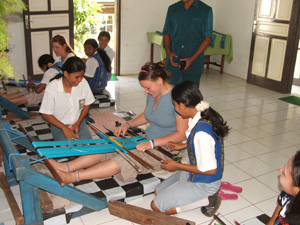
Girls in Saumlaki showing Amanda the craft of weaving
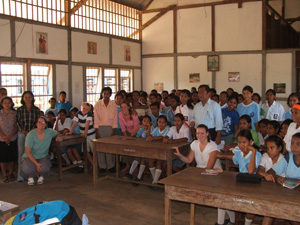
Teaching at the school in Saumlaki
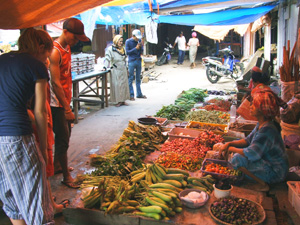
The pasar - market - this one in Kumai could be anywhere
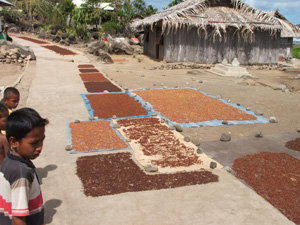
Cloves on Damar, drying in the sun
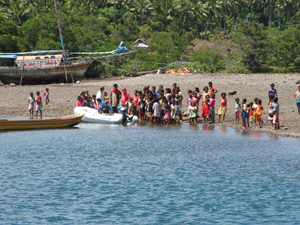
Many children greet us when we land on Damar
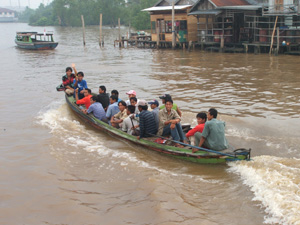
A water taxi in Banjarmasin, Kalimantan
1
Kumai
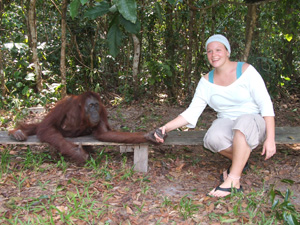
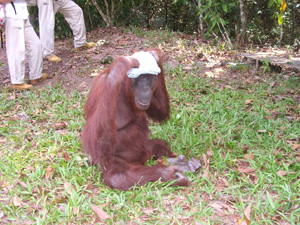
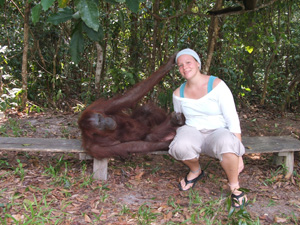
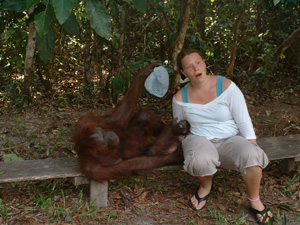
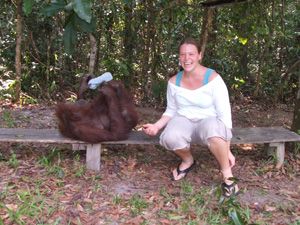
Orang is Indonesian for person; utan is forest; orangutan—person of the forest.
Our transportation is two, twenty-foot long, covered wooden craft called klotoks, so-named by the sound of the long-stroke, single-cylinder diesel engine. “KLOtok-KLOtok-KLOtok” (page 114)
5
2
3
4